

Talking Landfill Diversion, B Corp and the Psychology of Stuff on Grounded in Maine.
Trash & Stash founder Cameron Ungar joined the Grounded in Maine podcast for a wide-ranging conversation about landfill diversion, conscious consumption and the surprisingly human side of junk removal.
When Cameron Ungar started Trash & Stash in 2021, the idea seemed relatively straightforward: help people get unwanted stuff out of their homes.
Five years later, he sees the business very differently.
In Episode 209 of Grounded in Maine, host Amy Bolduc sat down with Ungar to talk about the origins of Trash & Stash, its approach to sustainability, the company’s B Corp certification—and what thousands of junk removal jobs have taught him about our relationship with the things we own.
What emerged was a conversation that went well beyond junk removal.
A Business Born as an Act of Rebellion
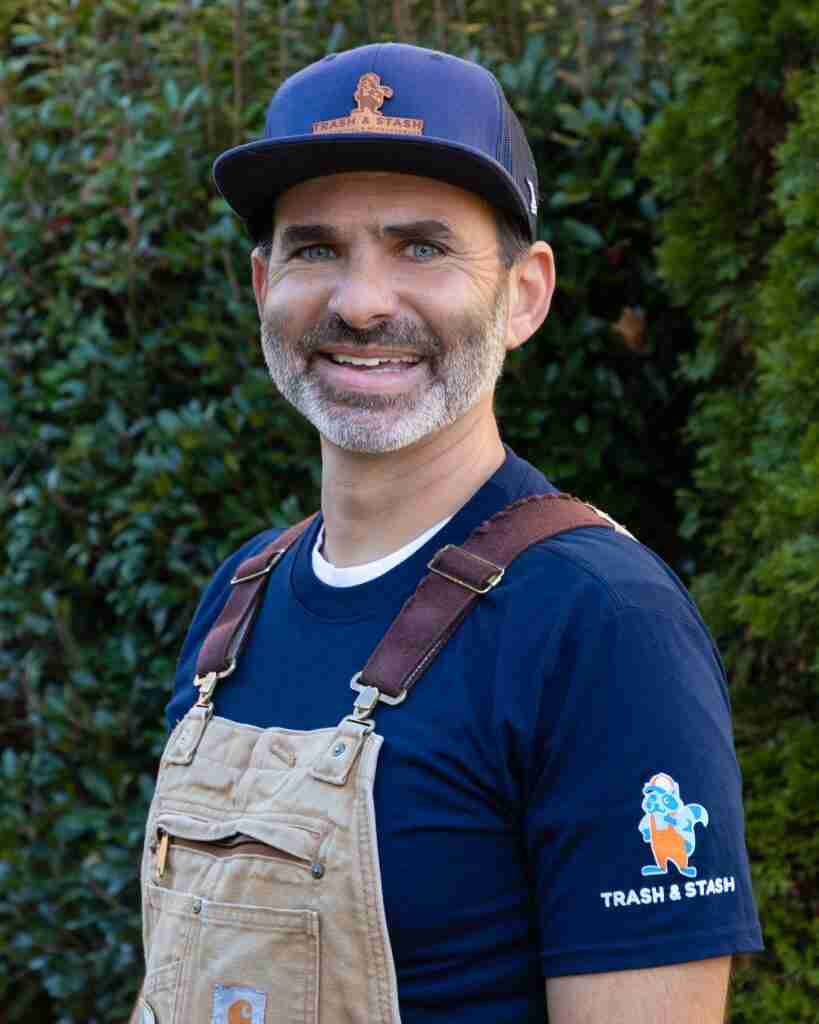
Before Trash & Stash, Ungar spent much of his career managing arenas, stadiums and event facilities. When COVID-19 shut down public assembly, he suddenly had an opportunity to rethink what came next.
At the same time, he was noticing something happening around him.
Garages were filling with belongings instead of cars. Storage facilities seemed to be appearing everywhere. Moving trucks filled neighborhood streets.
His own children were spending more time online and being exposed to an endless stream of things to buy.
“We have a stuff problem,” he remembers thinking.
That observation eventually helped inspire Trash & Stash.
Ungar describes starting the company as, in part, an act of rebellion against mass consumption—a way to help people simplify while finding better outcomes for the things they no longer needed.
He bought a Sprinter van despite never having stepped foot in a landfill and started taking jobs.
Five years later, that experiment has grown into a Charlotte-area company handling residential junk removal, recurring commercial waste services, office and warehouse decommissioning, event waste operations and material recovery.
The Psychology of Stuff
Perhaps the most meaningful part of the conversation is what happens when Bolduc asks about the “psychology of stuff.”
Junk removal often happens during significant moments of transition: death, divorce, downsizing, an empty nest or moving a parent into assisted living.

In those situations, an old china cabinet isn’t necessarily just furniture.
It may have belonged to someone’s mother.
A basement isn’t simply cluttered. It may represent decades of a family’s life.
And sometimes the physical stuff becomes intertwined with grief itself.
Ungar recalls working repeatedly with a woman whose husband had died unexpectedly. During their first visit, her home reflected how completely her life had been disrupted. Over the following six to eight months, Trash & Stash returned several times, removing a little more each visit.
Eventually, the team helped her move into a new home.
They had watched her life change alongside the space around her.
That experience is one of many that changed Ungar’s understanding of his own industry.
“There is a person here and the person was suffering.”
It’s why Trash & Stash trains its team to approach these environments without judgment.
Customers frequently apologize for their homes. Some feel overwhelmed. Others feel embarrassed or even ashamed about how much they’ve accumulated.
The team’s response is intentionally simple: show us the problem and let us help solve it.
“Junk Is a Verb, Not a Noun”
One phrase from the episode captures much of the Trash & Stash philosophy:
Junk is a verb, not a noun.
Ungar explains that one of the questions customers frequently ask is some version of:
“I don’t know if you do this, because my stuff isn’t junk…”

What they’re really saying is that the object still has value—it simply no longer has value to them.
That’s an important distinction.
The job isn’t necessarily to declare something worthless and dispose of it. It’s to determine what its next life can be.
For Trash & Stash, materials generally follow one of four paths: donation, resale, recycling or, when those options aren’t practical, disposal.
That philosophy has produced measurable results.
In the year discussed on the podcast, Trash & Stash handled more than one million pounds of material and diverted roughly 580,000 pounds from landfill—approximately 48%. That was up significantly from the roughly 30% diversion rate the company had previously achieved.

Why Reuse Comes Before Recycling
Recycling gets much of the attention in sustainability conversations, but Ungar argues that keeping something in use can be even more valuable.
Consider a bicycle.

If that bicycle is given to another person and remains a bicycle, all the value that went into producing it remains intact—the raw materials, manufacturing, labor, transportation and everything else required to create the finished product.
Recycle it and you may preserve the material.
Reuse it and you preserve much more of the value already embedded in the object.
That thinking led Trash & Stash to develop its “second life” approach to usable goods.
The company operates a warehouse and resale program, works with multiple donation partners and contributes a portion of resale proceeds to the Isabella Santos Foundation.
The philosophy extends to Trash & Stash itself. Ungar estimates that nearly his entire office—from desks and a conference table to the television and even the headphones he wore during the podcast—was recovered from jobs.
The total cost to furnish the office?
Roughly $1,000, primarily for computers and phones.
Aligning Profit With Purpose
Trash & Stash became B Corp certified in March 2024, becoming the first junk removal company in the United States to earn the certification.
But Ungar emphasizes that B Corp isn’t simply a marketing badge.
He describes it as a North Star that helps the company evaluate decisions involving its environmental impact, employees, customers, community and governance.
One example is the company’s employee efficiency bonus.
Trash & Stash targets daily operating expenses such as fuel and disposal fees at 10% of revenue. When the team brings those costs below the target, a portion of the savings becomes an employee bonus.
That means employees can directly benefit from running more efficient routes, using more fuel-efficient equipment and finding alternatives to landfill disposal through donation, resale and recycling.

During one month discussed on the podcast, those expenses fell below 4%.
Purpose and profitability weren’t competing with one another. The more efficiently the team operated, the better the environmental outcome and the greater the financial reward for employees.
Sustainability Doesn't Require Perfection
One of the most important themes in the conversation is that responsible consumption doesn’t require perfect behavior.
Trash & Stash didn’t jump from zero landfill diversion to 100%.
The company hovered around 30%, improved to nearly 50%, and continues looking for ways to get better.
Ungar applies the same thinking to consumers.
Buy secondhand when it makes sense.
Borrow a tool from a neighbor rather than buying something you’ll use once.
Choose durable products when possible.
Repair something rather than immediately replacing it.
And think about the entire life of an item before bringing it into your home.
Ungar uses the word “thrifty,” but not as a synonym for cheap.
To him, thriftiness means respecting the effort and resources that created something in the first place.
The same applies to money. Every dollar earned required someone’s time and effort, so spending it thoughtfully honors what went into earning it.
Building a Better Business—Not Just a Bigger One

The episode also offers a candid look at entrepreneurship.
Trash & Stash grew revenue by roughly 40% in one year—but became less profitable in the process.
That forced Ungar to reconsider the conventional obsession with scaling.
More jobs require more trucks. More trucks require more employees. More employees require more management.
So the question changed.
Instead of simply asking “How do we get bigger?”, Trash & Stash began asking how it could become better.
That has meant pursuing larger commercial decommissioning projects, developing recurring commercial services, expanding resale and recovery capabilities, and focusing on incremental, sustainable growth.
It’s another version of the same lesson that runs throughout the episode:
More isn’t always better.
That applies to the things in our homes.
And sometimes it applies to businesses, too.
Listen to the Conversation

Cameron Ungar’s full conversation with Amy Bolduc appears in Episode 209 of Grounded in Maine, “Landfill Diversion with Trash and Stash CEO Cameron Ungar.”
The discussion covers Trash & Stash’s unlikely beginnings, the circular economy, B Corp certification, employee incentives, conscious consumption, commercial and
event waste, entrepreneurship and the deeply personal experiences that happen when you’re invited into people’s homes during moments of transition.
And perhaps the simplest takeaway is also the most useful:
Make the better decision as often as you can.
You don’t have to be perfect to make a meaningful difference.
Read the Full Conversation
This article was adapted from my conversation with Amy Bolduc on Episode 209 of the Grounded in Maine podcast, “Landfill Diversion with Trash and Stash CEO Cameron Ungar.”
Our conversation went well beyond recycling and junk removal. We talked about the origins of Trash & Stash, consumerism, the emotional connection people have with their belongings, reuse and resale, commercial and event waste, B Corp certification, the circular economy, and the challenge of balancing environmental responsibility with the realities of running a profitable business.
Expand the section below to read an edited transcript of our full conversation.
Full Podcast Transcript: Cameron Ungar on Grounded in Maine
Amy Bolduc: Hi there, thank you so much for listening to Grounded in Maine. My guest today is Cameron Ungar of Trash & Stash. This conversation fits really well with some of our recent episodes about recycling and composting because we’re talking about junk removal and diverting material from the landfill. Cameron, I’m really excited to learn from you. Thank you for your time today.
Cameron Ungar: Thanks for having me.
What Is Trash & Stash?
Amy: Can you tell us what Trash & Stash is and how you got here?
Cameron: For all intents and purposes, we’re a junk removal company, like the big names you see rolling around your city streets.
We come into people’s homes, and typically we’re working with people in moments of transition. Sometimes it’s seasonal, but often people are going through death, divorce, an empty nest, or helping parents move into assisted living. Something is happening, and the stuff in their life has become problematic.
We come in and help resolve that, and we try to do it as sustainably and responsibly as we can so the things we put our hands on get a shot at a second life when they’re in condition to do so.
How I got here is a longer story.
Trash & Stash Was a COVID Baby
Cameron: My previous career was in arena management. I managed stadiums and arenas and spent most of my career on college campuses. I’m originally from San Diego, and I managed several 5,000-seat basketball arenas, baseball stadiums and other facilities.
What I loved about the events business was that it was multidisciplinary. You’re working on all sorts of things. It’s a bunch of different businesses coming together at once, all happening on a very finite deadline.
Then there’s a global pandemic and the public can no longer assemble.
When your business is public assembly, you have to think about what’s next.
I was actually pretty resigned to moving away from that career. I loved what I did, but it’s tough. It’s nights and weekends. You’re working while everybody else is recreating. You work a full office day, tipoff is at seven, then you’re working through the game and tearing everything down afterward to turn the building over for tomorrow.
For me, it was hard to raise a family in that lifestyle.
So I was ready for a change.
I didn’t feel like COVID had necessarily taken something from me. I looked at the pandemic as an opportunity to figure out what was next. There aren’t many opportunities when you’re around 40 years old to reinvent yourself.
I knew everybody suffered in their own way during that period, and it wasn’t easy. But for me, it created an opportunity to ask what I wanted to do next.
A “Sweaty Startup” and an Act of Rebellion
Cameron: I loved the idea of a sweaty startup. I wanted to go out and work with my hands.
I had started to feel like a widget—a middle manager. In the absence of people or a building to manage, I started asking myself: how can I go out, earn and prove my worth by actually doing something tangible?
At the same time, I couldn’t completely start over as a plumbing or electrical apprentice because I still had a family to support.
Then I started looking around Charlotte.
I saw garages full of stuff instead of cars. Moving trucks seemed to be everywhere. Storage units seemed to be going up faster than houses.
I thought: we have a stuff problem.
At the same time, my kids suddenly had screens in their hands more often. They were asking to buy things they had never asked for before.
They were being sold things they didn’t need and hadn’t even known they wanted.
I started wondering how I could rally against this mass consumerism.
Trash & Stash became a little bit of an act of rebellion for me:
Let’s stop overconsuming. Let’s start simplifying.
I bought a Sprinter van. I had never stepped foot in a landfill in my life.
I had this truck sitting in my driveway, and every day it wasn’t running was a day it wasn’t making money.
So we got to work.
That was April 2021.
Building a Junk Removal Business
Amy: And you’ve got something bigger than a Sprinter van now, I assume?
Cameron: We do, although not much bigger.
We have a heavy-duty pickup and a retired U-Haul 10-foot box truck named Bella. The guys actually really like that truck. It’s fuel efficient, easy to operate and can get into tight spaces.
We’ve also gotten really good at packing trucks.
That’s one of the differences when you’re comparing full-service junk removal with something like a dumpster rental.
Dumpster rentals absolutely have their place—we offer them too—but sometimes you’re paying for a lot of air. You may only use 15 yards of a 30-yard dumpster, but you’re paying for the entire dumpster.
With full-service junk removal, you’re paying for the actual space you use, and we’ve become pretty good at maximizing that space.
Why Overwhelm Drives So Many Calls
Amy: Is business good in Charlotte?
Cameron: It is. We’re busy.
One challenge is that junk removal isn’t necessarily a subscription business like housekeeping. We have to continually generate work.
But we do get a fair amount of repeat business because customers realize how easy it can be.
Overwhelm is a big word for our customers.
People will sit there looking at all this stuff until eventually they hit that pain-versus-pleasure threshold. Usually they’re calling us because the pain has reached a point where they have to do something about it.
Then they realize it doesn’t necessarily have to be a huge problem.
We can come in and make it go away.
Once people understand that, they often call us again.
Junk Removal Isn't Only Residential
Cameron: We also do a lot of commercial work.
For example, we work with a shower-door company. We come out every couple of weeks and pick up the shower doors they remove from customers’ homes.
They’ve recognized that sending skilled technicians to the dump is wasteful.
Those technicians should be installing.
There’s an opportunity cost to sending them to a landfill, along with vehicle wear and tear and everything else associated with that trip.
It’s a better use of their resources to have us handle it.
We also do eviction cleanouts for apartment communities, clean dumpster enclosures where bulk waste has accumulated, and handle office and warehouse decommissioning.
Bringing Sustainability Back Into Events
Amy: Since you came from event management, are you getting involved with colleges or events again?
Cameron: More and more.
We’ve started doing event waste work at festivals, concerts and sporting events.
We’ll put out collection receptacles, sort material onsite and provide diversion reporting afterward.
For events trying to move toward zero waste or improve landfill diversion, we can help make sure bottles, cans, cardboard and other materials actually go where they’re supposed to.
What’s interesting is that so much of traditional junk removal is reactionary.
We’re reacting to a consumer decision that has already been made.
With events, if we can get involved earlier, we can help make some of those decisions on the front end.
If an event really wants to move toward zero waste, we can look at where they were last year, establish a goal for next year and identify what has to change to get there.
The Hidden Waste of Temporary Events
Cameron: We’ve also had conversations with the Charlotte visitor community about conventions and trade shows.
Events are temporary by nature, which can make them incredibly wasteful.
A trade show may come into town and buy six couches from Wayfair because buying them is cheaper or easier than renting them.
Then six days later, the show is over.
Now what happens to those couches?
I’ve seen shows leave behind things like 16 picnic tables.
And that doesn’t even include all the packaging, shipping material and other things that come with roadshows.
The challenge becomes finding a responsible next use for something that was purchased for an incredibly short-term need.
That’s where we can work with donation partners or our resale program to keep those things in circulation rather than treating them as disposable.
The Job That Changed How We Thought About Waste
Cameron: I remember one job very early in Trash & Stash.
We were in a woman’s house after her husband had passed away. She had this huge basement full of stuff.
It wasn’t a hoarding situation. They were collectors. It was essentially a lifetime of accumulated belongings.
She didn’t know where to start.
As we walked through, she would point:
“That can go.”
“This can go.”
“That can go.”
There wasn’t necessarily a rhyme or reason to it, but I could tell she was selecting the things she didn’t personally have a connection to.
There was so much stuff that it was creating noise for her. She needed to thin it out before she could deal with the harder decisions.
We loaded everything up.
Then we took a lot of it to the landfill.
I remember looking at the guy I was working with and thinking:
This feels bad. This feels wrong.
We had solved her immediate problem.
We helped alleviate some of that noise and stress and allowed her to begin moving through the grieving and household-management process.
But then we drove to a landfill and contributed to this much larger problem.
I wasn’t sure we had really solved anything.
That experience helped lead to our Second Life program.
Finding a Second Life for Things
Cameron: We started asking what else could happen to the things we remove.
There are basically a few possibilities.
We can donate something.
We can resell it.
We can recycle the material.
Or, when those options don’t make sense, it may ultimately need to be disposed of.
For resale, we operate out of a warehouse and have a small showroom that’s essentially a thrift or antique space.
We also partnered with the Isabella Santos Foundation, which supports pediatric cancer research.
A portion of our resale proceeds goes to the foundation.
There was another reason for structuring it that way.
If a customer pays us to remove something and then sees us selling it, I don’t want them to think we’re simply double dipping.
There’s real expense associated with moving, storing, marketing and selling those items, but we also wanted the resale program to clearly create something positive beyond our own bottom line.
“My Stuff Isn't Junk.”
Cameron: We hear a version of this constantly:
“I don’t know if you do this because my stuff isn’t junk.”
For a while, I took that literally.
Eventually I realized that wasn’t really what people were asking.
What they’re saying is:
This is no longer useful to me, but I still believe it has value.
They want to know what’s going to happen to it.
Can somebody else use it?
Can it be donated?
Can it be recycled?
Is it just going to be thrown away?
That matters to people.
Why Junk Removal Can Be Deeply Personal
Cameron: We’re often helping people during major transitions.
Death.
Divorce.
Empty nesting.
Moving.
Assisted living.
Estate cleanouts.
The stuff isn’t always just stuff.
A china hutch may mean absolutely nothing to the adult child who has to empty the house.
They don’t want it. They don’t need it.
But it meant something to their mother.
So now preserving that object—or at least knowing that somebody else will appreciate it—can become a way of honoring something their parent valued.
That’s one of the things I’ve learned doing this work.
The physical object can carry emotional value that has nothing to do with its resale value.
The Circular Economy: Keeping a Bicycle a Bicycle
Cameron: I’ve really been geeking out on the circular economy.
I often use a bicycle as the simplest example.
Suppose we pick up a bicycle from someone’s house.
If we donate it or resell it and someone else continues using it as a bicycle, that’s great.
The bicycle has material value—the metal, rubber and other materials that went into it.
But there’s also all the value that went into turning those materials into a bicycle.
Manufacturing.
Labor.
Transportation.
Distribution.
Sales.
All of that energy and value already exists in the finished product.
If it stays a bicycle, you retain all of that.
If we recycle it, we lose some of that embedded value, but at least we preserve the raw material.
That’s still better than throwing it away and losing everything.
That’s what makes reuse so powerful.
Humans Have Always Reused Valuable Materials
Cameron: At one point I started researching the history of throwing things away.
I was reading about ancient societies and even things like bricks.
Historically, it took enormous effort and resources to make something like a brick.
If you could reuse an existing brick, you had already shortcut much of that process.
The hard work had already been done.
There’s an environmental argument for that, but there’s also an economic argument.
If businesses can recover resources and materials and shortcut parts of the manufacturing or resource-acquisition process, circularity can actually be good for business.
Our resale operation is a simple example.
The material comes to us through our junk-removal operation. We don’t have a traditional acquisition cost for inventory.
If we can preserve that value, it creates an entirely different economic opportunity.
Fast and Convenient Isn't Always the Best Choice
Cameron: I think we have to become more thoughtful about what we buy and what we bring into our homes.
Fast and convenient isn’t always the best choice.
I’m not saying that from some position of perfection. Amazon comes to my house too.
But doing this work has made me much more aware of the back end of those purchasing decisions.
Eventually, somebody has to deal with the thing.
Recycling Isn't the First Choice
Cameron: One thing that’s changed for me is understanding that recycling isn’t necessarily the highest and best outcome.
People hear “recycling” and think that’s the environmental answer.
It’s certainly better than landfill in many cases.
But if something can continue functioning in its current form, that’s usually better.
Going back to the bicycle:
Keeping a bicycle a bicycle preserves far more value than melting it down and turning it into raw material again.
So our hierarchy is really about trying to preserve the highest value possible.
Reuse first when practical.
Then recycling.
Then disposal when that’s the reasonable remaining option.
The Economics of Diversion
Cameron: To the junk removal industry’s credit, there are financial incentives to divert material.
If I can take metal to a scrapyard and get paid $30 instead of paying $30 to dump it, that’s a $60 swing.
Even if we donate something and don’t get paid for it, we may avoid a disposal cost.
So responsible decisions and profitable decisions don’t always conflict.
Sometimes they’re the same decision.
The bigger issue is accountability.
That’s one reason B Corp has mattered to us.
We track our diversion numbers. We make them public.
If we’re at 30%, we say we’re at 30%.
I think transparency matters.
Why Trash & Stash Became a B Corp
ameron: B Corp gave us a framework for thinking about what kind of business we wanted to be.
It’s easy for a company to say it’s environmentally responsible or socially responsible.
B Corp creates an outside accountability mechanism.
It forces you to look at your workers, your community, your environmental practices and the way the business is governed.
For us, it helped formalize things we were already trying to do and challenged us to keep improving.
Sustainability Has to Work as a Business
Cameron: There’s a really interesting place in Charlotte called the Innovation Barn.
It’s designed as a working model of the circular economy, and they’ve done some very cool things.
For example, they’ve worked with the Spectrum Center to recover glass after events, crush it and find uses for it in products like concrete.
Our team used to volunteer there.
The guys would leave incredibly motivated.
“What if we did this?”
“What if we did that?”
I loved those conversations.
But we also had to recognize a fundamental difference.
The Innovation Barn exists in part to demonstrate what’s possible.
We’re a self-funded operating business.
We have payroll.
We have trucks.
We have rent.
We have to maintain cash flow.
We can’t participate in every experimental solution simply because it’s environmentally interesting.
We can be inspired by it, learn from it and apply what makes sense.
But sustainability also has to be economically sustainable.
If the business doesn’t survive, none of the good work survives either.
Perfection Can Become the Enemy of Progress
Cameron: This is something I’ve had to become more comfortable with.
We’re not perfect.
There are things we put into the landfill.
I wish that weren’t true, but it is.
The question isn’t whether we can magically save everything.
The question is:
Can we make the better decision more often?
Our diversion rate has improved substantially over time.
That matters.
If you’re moving from keeping 30% out of the landfill to keeping nearly half out, that’s hundreds of thousands of additional pounds being handled differently.
You can’t dismiss that progress simply because you haven’t reached 100%.
The Scale Changes Your Perspective
Cameron: Last year we handled more than a million pounds of material.
When you start thinking in those numbers, your perspective changes.
And then you sit at a landfill and watch the trucks.
One after another after another.
That’s one landfill.
In one area.
Then you multiply that across every city and county in the country.
It makes the consequences of our consumption much harder to ignore.
Event Waste Starts Before the Trash Can
Cameron: That’s one reason I find the event side so interesting.
When we’re doing residential junk removal, the consumption decision may have happened five, ten or thirty years earlier.
We’re reacting to it.
With an event, you may have an opportunity to intervene before the material ever becomes waste.
What products are you purchasing?
What kind of serviceware are you using?
Where are your collection points?
How are they labeled?
What infrastructure exists locally to process what you’re collecting?
You can make decisions at the beginning that dramatically change what happens at the end.
Commercial Decommissioning and the Value-Loss Problem
Cameron: The same principle applies to offices and warehouses.
A company may be moving or closing a facility and suddenly have desks, chairs, monitors, shelving and other equipment that has to disappear on a deadline.
By the time someone calls a junk removal company, some of the opportunity to preserve value may already be gone.
If we can get involved earlier, there may be time to identify donation partners, resale opportunities, recyclers or other outlets.
The earlier the disposition conversation happens, the more options you generally have.
Once the deadline is tomorrow, convenience starts winning.
The Problem With Treating Everything as “Waste”
Cameron: That’s part of why language matters.
If you label something “waste,” you’ve already made a decision about its value.
But maybe it’s not waste.
Maybe it’s an asset that is no longer useful to you.
That’s different.
The question becomes whether there’s still another useful life for it somewhere else.
Why Thrifty Is a Good Word
Cameron: I’ve started using the word thrifty more.
Not cheap.
Thrifty.
There’s value in being thoughtful about how we use resources.
Our employees work hard for the money the company earns. They lift things, carry things, sweat, take care of customers and solve problems.
We should respect that effort when we decide how to spend those dollars.
The same is true personally.
Our purchases represent our own labor and time.
Being thoughtful about that isn’t deprivation.
It’s respecting the resources that went into earning the money and making the product.
Buy Less, Buy Better, Borrow More
Cameron: I’m not suggesting people stop buying things.
That’s unrealistic.
But there are questions worth asking.
Do I need to own this?
Could I borrow it?
Could I buy it secondhand?
Can I repair the one I already have?
If I’m going to buy it, is there a version that’s designed to last?
And when I’m finished with it, is there still useful life left for someone else?
Those decisions on the front end can have a huge impact on what eventually happens on the back end.
Think Globally, Act Locally — or Just Think Locally
Cameron: We hear “think globally, act locally.”
I’ve increasingly thought:
Think local. Act local.
Focus on making your little corner of the world better.
If enough people do that, it scales.
We don’t have to solve the entire global waste problem tomorrow.
We can make a better decision with the bicycle.
A business can find another home for 16 picnic tables instead of throwing them away.
An event can change the way it purchases disposable materials.
A family can donate something while it still has useful life.
A junk removal company can improve its diversion rate from 30% to nearly 50%.
Those things compound.
Helping People Solve the Actual Problem
Cameron: At the end of the day, I think our job is to understand what problem somebody is actually trying to solve.
Sometimes we’re the answer.
Sometimes we’re part of the answer.
And sometimes the best thing we can do is tell someone:
“Call this organization. They’re better equipped to help you with that.”
We’re not trying to get rich on any one job.
We want to serve as many people as we can, but we also want to do it honorably and admirably.
If we can help solve someone’s problem—even if we’re not ultimately the people putting our hands on the material—we’re happy to do that.
Kindness and Judgment-Free Service
my: I really appreciate the thoughtfulness behind what you’re doing.
When people lose someone, collect things or become overwhelmed, it can feel incredibly personal. There’s often shame involved.
I love that you’ve built a company around people who are patient, kind and nonjudgmental.
Letting go of things can involve grief. Having someone come into your space without judging you can make such a difference.
So thank you for that, and thank you for the thoughtfulness toward the earth.
Cameron: Thank you for saying that. I appreciate it. That means a lot.
This is definitely not where I expected to be, but I’m glad to be here.
Amy: Thank you for sharing so much and for your time today.
Cameron: Absolutely. Thanks for the opportunity.
