

Making the decision to finally let go.
What five years in junk removal has taught me about clutter, consumerism, transitions—and making the decision to finally let something go.
I recently joined Heather Clark on the Declutter for CHANGE podcast for a conversation about something I’ve gotten a pretty unusual education in over the last five years:
Why do we have so much stuff—and why can getting rid of it be so difficult?
When I started Trash & Stash, I wasn’t thinking much about the psychology of clutter.
I saw garages full of stuff instead of cars. Storage facilities seemed to be going up everywhere. Moving trucks were constantly on the road. Meanwhile, my own kids were spending more time on screens and being relentlessly marketed things they had never known they wanted.

Collectively, it seemed like we had a stuff problem.
So I bought a truck, parked it in my driveway and started a junk removal company.
I had never even been to a landfill.
Five years later, after putting our hands on millions of pounds of other people’s belongings, I’ve learned that the stuff itself is often the simplest part of the equation.
Stuff Isn't Just Stuff
Heather asked me why I think people hold onto things.
There are probably hundreds of answers, but one comes up constantly in our work:
Things become physical representations of people, places and periods of our lives.
Maybe it’s your mother’s china hutch.
You don’t particularly like it. It doesn’t fit in your house. Your kids don’t want it.
But your mother loved it.
Suddenly, the decision isn’t simply, Do I want this piece of furniture?
It becomes:
What does getting rid of it mean?
Am I disrespecting something that mattered to her?
What if I regret it?
Could somebody else use it?
That’s a very different decision.
We see this constantly because so much of our work happens during transitions—death, divorce, downsizing, assisted living, moving, empty nesting and other moments when people’s lives are changing.
The belongings become intertwined with the transition.
Sometimes the Stuff Becomes Noise
One of the stories I shared with Heather was about a woman whose husband had recently passed away.
Her basement was filled with things they had accumulated together over a lifetime. It wasn’t trash. It wasn’t even really clutter in the way we usually think about clutter.
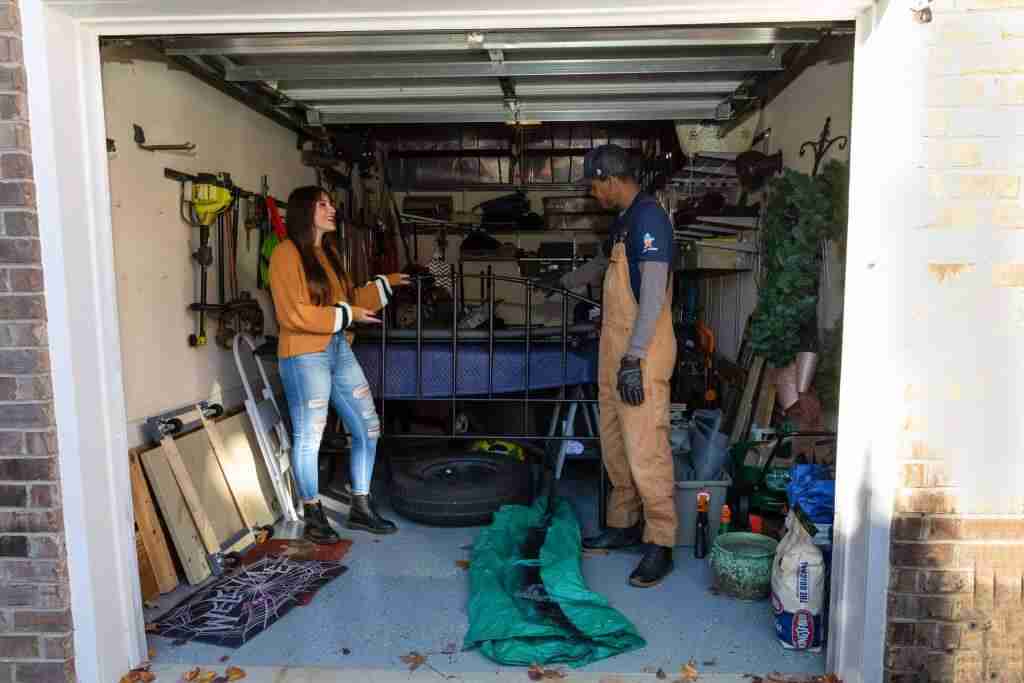
But I could see that it had become noise for her.
As we walked through the basement, she would point:
Take that.
Take that.
Take that.
She wasn’t ready to process everything. She was identifying the things that carried the least emotional weight and asking us to make those things disappear.
Removing them didn’t solve her grief.
But it reduced some of the physical and mental friction around her so she could begin dealing with everything else.
That’s something I’ve seen repeatedly.
Our physical environment can become background noise. Eventually, we stop consciously seeing the pile in the corner, the boxes in the garage or the room we can barely use anymore.
But that doesn’t necessarily mean it isn’t affecting us.
A customer once gave me a wonderfully simple phrase for it:
“Messy head. Messy bed.”
Sometimes changing the physical environment creates enough space to begin changing something else.
Usually, Something Changes Before We Get the Call

People don’t generally wake up on a random Tuesday morning thrilled about spending money on junk removal.
Usually something has happened.
They’re moving.
A parent died.
Someone is going into assisted living.
They’re having a baby.
The kids left home.
They’re renovating.
They’re selling the house.
Or the accumulation has simply crossed a threshold where living with it has become more painful than dealing with it.
That’s when the phone rings.
And sometimes you can hear the overwhelm immediately.
“I don’t even know where to start.”
That’s a phrase we hear a lot.
My answer is usually some version of: That’s okay.
If you need someone to carefully work through every box with you and help decide what stays and what goes, a professional organizer may be the right first call.
But if you’ve reached the point where you’re ready to say, “That goes,” we’re really good at making it go.
Those are different jobs, and both can be important parts of the process.
Start With an Easy Decision

Heather asked what advice I would give someone who feels overwhelmed by everything around them.
My answer wasn’t particularly profound:
Start small.
Don’t begin with your late father’s box of photographs.
Start with the bathroom cabinet.
Start with a closet.
Start with the things that don’t carry much consequence.
Decluttering requires decisions, and decisions get easier with practice.
At the beginning, someone may deliberate over every shirt.
Keep?
Donate?
Maybe?
Then something starts to happen.
Keep. Go. Go. Keep. Go.
Momentum builds.
The decisions become easier.
And eventually you’re better prepared to tackle the things that actually carry emotional weight.
We're Really Good at Bringing Stuff In
Of course, getting rid of things is only half of the equation.
We also talked about why so much stuff enters our homes in the first place.
We’re extraordinarily good at consumption.
We’re marketed to constantly. Buying something can provide a little dopamine hit. And when an item is inexpensive enough, the decision barely feels consequential.
Then we walk into homes and find brand-new items with tags still attached from Target, HomeGoods, Ross and countless other stores.
They were purchased.
They went into a closet.
They were forgotten.
Eventually someone pays us to take them away.
I told Heather a story about taking my 13-year-old daughter into Five Below. She walked around for a while and finally told me there wasn’t anything she wanted because everything seemed crappy.
My response was basically:
It was always crappy.
What changed was her perception of it.
She had begun asking a different question:
Do I actually want this?
That’s a question worth asking before something enters our homes—not only when we’re trying to figure out how to get it back out.
The Best Junk Removal Might Be the Junk Removal You Never Need
There is an obvious contradiction in what I’m saying.
I own a junk removal company.
Our business exists because people buy things and eventually decide they don’t want them anymore.

So encouraging people to buy less, buy secondhand, borrow, repair things and keep products longer isn’t exactly the textbook strategy for increasing demand.
But I think that’s part of our responsibility.
We have a front-row seat to the back end of consumerism.
I’ve sat in line at the landfill watching truck after truck after truck unload material onto an ever-growing pile.
And that’s one landfill.
In one part of one county.
Multiply that across the country.
It changes the way you look at things.
“My Stuff's Not Junk.”
There’s another phrase we hear all the time:
“I don’t know if you do this, because my stuff’s not junk.”
For a long time, I took that question literally.
Eventually I realized that people were telling us something much more important.
This may no longer be useful to me, but I believe it still has value.
That’s different.
Our responsibility then becomes figuring out whether that value can be preserved.
Can it be donated?
Can it be resold?
Can someone else use it?
Can the material be recycled?
Or, after exhausting the reasonable alternatives, does it need to be disposed of?
That’s where decluttering intersects with the circular economy.
A Bicycle Is More Than Metal
I used a bicycle as an example during our conversation.
Suppose your child outgrows a bicycle.
We could throw it away.
Problem solved—for you.
We could recycle it. That’s better because we’re preserving some of the material value in the metal and other components.

But if we can donate or resell that bicycle and another child continues riding it, we’ve preserved far more value.
Think about everything that went into creating it.
Raw materials.
Manufacturing.
Labor.
Packaging.
Transportation.
Distribution.
Retail.
All of that value already exists inside the finished bicycle.
Keeping it functioning as a bicycle preserves more of that value than breaking it back down into raw material.
That’s circularity in its simplest form.
Instead of:
Make → Buy → Use → Trash
we try to keep things circulating.
Reuse them.
Repair them.
Resell them.
Donate them.
Recycle them when necessary.
And ideally, make better decisions about what we buy in the first place.
Sustainability Doesn't Require Perfection
There’s one other lesson I’ve had to learn running Trash & Stash.
We can’t save everything.
Last year we handled more than a million pounds of material and kept roughly half of it out of the landfill.
I’m incredibly proud of that.
I’m also very aware of what the other half means.
There are times when the economics, logistics, condition of the material or realities of operating a business mean something goes to the landfill.
That’s uncomfortable for a company that talks publicly about circularity.
But I’ve come to believe that sustainability can’t be about perfection.
If trying to be perfect makes the business unsustainable, eventually the business disappears—and then none of the good work happens.
The better question is:
Can we make the better decision more often?
A few years ago, we were diverting closer to 30% of what we handled.
Now we’re around 50%.
That’s hundreds of thousands of additional pounds staying out of the landfill.
Progress matters.
Think Local. Act Local.
We hear the phrase think globally, act locally.
I’ve increasingly simplified that.
Think local. Act local.

Make your little corner of the world better.
Buy the durable thing when you can.
Borrow something you’ll only use once.
Buy secondhand.
Repair instead of replace.
Donate something while it still has useful life.
Start with one closet instead of becoming paralyzed by the whole house.
Make one easy decision.
Then make another.
If enough of us make the better choice more often, those small decisions eventually become something much larger.
You don’t have to be perfect.
Neither do we.
Just make the best choice you reasonably can, as often as you can.
That’s probably the biggest thing five years of dealing with everyone else’s stuff has taught me.
I joined Heather Clark for Episode 067 of the Declutter for CHANGE podcast, “What A Junk Removal Expert Wants You To Know About Your Clutter.” We talked about clutter, emotional attachment, consumerism, junk removal, the circular economy, B Corp certification and what happens to our stuff when we’re finally ready to let it go.
Listen to the full conversation: Spotify | Apple Podcasts | YouTube | Transcript
Read the full conversation.
This article was adapted from my conversation with Heather Clark on Episode 067 of the Declutter for CHANGE podcast, “What A Junk Removal Expert Wants You To Know About Your Clutter.”
We covered much more than we could include in the article above, including the origins of Trash & Stash, why people become emotionally attached to their belongings, the relationship between clutter and major life transitions, consumerism, the circular economy, B Corp certification, landfill diversion, and why sustainability doesn’t have to mean perfection.
Expand the section below to read an edited transcript of our full conversation.
Full Podcast Transcript: Cameron Ungar on Declutter for CHANGE
Heather Clark: Cameron, thank you so much for coming on the show. What you and your business do fits so well with Declutter for CHANGE. Tell us how you got into this work, why you started the business, and what you stand for as a company.
Cameron Ungar: Getting into the junk removal business was definitely not on the bingo card of life for me. It wasn’t part of the master plan.
Trash & Stash was really a COVID baby.
My previous career was in the events business. I used to manage stadiums and arenas, and I spent most of my career on college campuses working in 5,000-seat basketball arenas and similar facilities.
The events business is interesting because it’s incredibly multidisciplinary. Your hands are involved in a little bit of everything. I used to joke that the finale of The Apprentice was always an event because you have all of these different business functions happening within this incredibly compressed timeline.
You plan and plan and plan, and then the doors open and suddenly you’re reacting.
That was my career up until 2020.
When you’re in the business of public assembly and suddenly the public can no longer assemble, you have to figure something else out.
I liked that line of work, but I was also ready for a change. You’re working when everyone else is recreating, and I have three kids. I was looking for a little more work-life balance.
Losing your job is never easy, but COVID also created this unusual opportunity to reinvent myself, explore and study what I might want to do next.
I liked the idea of a “sweaty startup.” I wanted to go out, work and earn with my hands. I had reached a point where I felt like a widget—a middle manager—and in the absence of a facility and people to manage, I started asking myself how I could actually provide something tangible.
From Event Sustainability to Junk Removal
Cameron: Sustainability had already been part of my thinking from my days in events.
I was always interested in running leaner, greener events. At one point, we started doing a “green game” during basketball season. Once a year we’d try to make a televised game zero waste. We’d share environmental facts and make a ceremony out of our ushers coming through and collecting material.
The idea was simple: if we can do this for one game, why can’t we do it for every game?
Then, during COVID, I started looking around.
I saw garages full of stuff instead of cars. Moving trucks seemed to be on every street. Here in the Charlotte area, it felt like storage facilities were being built faster than houses.
Collectively, we seemed to have a stuff problem.
At the same time, I was watching my kids. They had never really had screen issues before, and suddenly they were glued to screens and being sold things they didn’t need—things they had never even wanted before somebody put that screen in their hands.
There was this really aggressive consumerism happening.
I didn’t want to contribute to that.
So my reaction was almost the opposite: let’s make some of this stuff go away.
Trash & Stash started as my little fist in the air against mass consumerism.
Junk removal also had a relatively low barrier to entry compared with becoming an apprentice plumber or electrician. It was a trade I could actually go out and start.
So I bought a truck and parked it in my driveway.
At that point, I had never even stepped foot in a landfill.
That’s how we got rolling.
The Job That Changed How I Thought About “Junk”
Heather: When did you have the realization that simply collecting things and taking them to the dump wasn’t enough?
Cameron: There were probably two things.
The first was that consumerism piece I mentioned.
The second was a very specific job.
We were in a woman’s house after her husband had passed away. She had a basement full of things. It wasn’t a hoarding situation. They had simply been collectors, and this basement represented a lifetime of accumulation.
We walked through the basement and none of it was really trash. It was all nice stuff.
She would point almost randomly:
“Take that.”
“Take that.”
“Take that.”
You could tell the stuff was creating noise in her head. There was friction and heaviness associated with all of it.
The things she was asking us to remove tended to be the things she wasn’t personally connected to.
It was almost like: Just make that go away. Make that go away.
Removing those things gave her the ability to begin dealing with the gravity of everything else—the loss and the more emotional possessions.
We took everything out of the house.
Then we’re standing at the landfill throwing it away, and we’re thinking:
This feels bad.
We had helped her. We solved her immediate problem. She could move forward with the next steps of grieving and managing her household.
But now we’re contributing to this other problem.
There’s an endless stream of trucks entering this landfill. The pile keeps getting bigger, and we’ve just added to it.
So had we really solved anything in the grand scheme of things?
That became an important question for us.
Donation, Resale and Finding a Second Life
Cameron: We started with donation.
But donation isn’t the answer for everything.
You can take an armoire to Habitat for Humanity and they may not want it. The same can happen with a huge executive desk. Maybe it’s too big or too heavy. There’s still value there, but there’s a very specific audience for it.
So we started asking whether we could resell some of those items.
That became our Second Life program.
Then we ran into another issue: how would customers feel about paying us to remove something and then seeing us sell it?
They might perceive that as double dipping.
The reality is that there are costs involved in taking something, transporting it, warehousing it, listing it and finding a buyer. But we didn’t want to constantly defend our intentions.
So we partnered with the Isabella Santos Foundation, which raises money for rare pediatric cancer research.
We began donating half of the proceeds from those sales to the foundation. The other half went back to our crew as a bonus.
That was intentional too.
Going to the dump is easy.
When you’re doing multiple jobs every day, protecting an item, transporting it somewhere else and finding another home for it requires additional effort.
If we could incentivize our team to make the better choice more often, that’s how we wanted our system to work.
It all evolved pretty organically.
Why Do We Hold Onto Things?
Heather: Why do you think people become so attached to their stuff?
Cameron: I think things become physical reminders of people and places.
It’s easy to look at an item and think, This reminds me of that person, that time or that place.
We work with people in transition all the time. Maybe they’re moving their parents into assisted living. Maybe a parent has passed away.
There’s often guilt involved.
You see an item and know that it meant something to the person who owned it. They were proud of it. They enjoyed it.
You may not get the same enjoyment from that item, but you preserve it because you’re trying to protect the feeling associated with that person.
Eventually, the item stops being just a thing.
It becomes a representation of a life that was lived or a person who was there.
That’s a lot of emotional weight to place on an object.
“Messy Head, Messy Bed”
Cameron: There’s another piece of this that we talk about as “messy head, messy bed.”
I don’t think we always realize how much friction or noise the things in our environment create.
Eventually, you get used to it.
There’s a pile of laundry in the corner and you stop seeing it. You walk past it every day.
Things can stay around much longer than they should simply because they’ve become part of the environment.
Our houses are designed to store a lot of things, and it requires effort to disrupt that perception of organization.
So it’s easier to leave it and not think about it.
We talk internally about pain versus pleasure.
Usually, when someone finally calls us, the situation has crossed the pain threshold.
They’re not necessarily finding joy in getting rid of something.
They’re trying to alleviate pain.
“I Don't Know Where to Start.”
Heather: Often something changes in someone’s life before they finally deal with the clutter. Someone passes away. There’s a new baby. They’re moving. The kids leave home. Then suddenly the amount of stuff becomes overwhelming because they don’t know where to begin.
Cameron: Absolutely.
We have those conversations all the time.
Someone calls and you can hear that they’re completely overwhelmed.
“I don’t know where to start.”
That’s when we ask what kind of help they actually need.
Are you looking for somebody to come in and just make it go away?
Because we’re really good at that.
We’re kind of the blunt tool.
But if you need someone to open every box with you and have the conversation about what an object means, whether you need it, and how to separate the thing from the person or memory it represents, that’s where a professional organizer may be the better resource.
We’ve worked alongside organizers in both types of situations.
Sometimes the organizer is saying:
“Keep. Go. Keep. Go.”
And when they say “go,” we put it on the truck so the client doesn’t have the opportunity to reconsider the decision.
Other situations require much more sensitivity.
Both are part of the process.
Practicing Decluttering
Cameron: Junk removal isn’t usually a recurring service like housekeeping, but we’ve talked to customers about developing a clutter-management plan.
Maybe we’re scheduled twice a year or quarterly.
Then you have the law of the imminent deadline working for you.
You know the guys are coming in three months, so you start making a pile. You start thinking about what you’re keeping. You become more intentional.
People get better at this when they practice it.
And when they realize how easy it can be to have someone come out and take care of the things they’ve decided to let go, that removes another barrier.
The Back End of Consumerism
Heather: We’re constantly being encouraged to buy things. Eventually we look around and wonder why we have all of it.
Cameron: There’s definitely a dopamine hit involved.
We see brand-new things with the tags still attached from HomeGoods, Target, Ross and other stores.
People get into the habit of buying.
These things aren’t necessarily intended purchases. You get a quick hit from buying something. It’s cheap enough that you don’t really have to think about the financial impact.
Then it ends up in a drawer, in a cabinet or in the back of a closet.
You forget you bought it.
It didn’t change your life one way or another.
Eventually, it’s one more thing that needs to leave.
We’ve become very vocal about the circular economy, which maybe isn’t the greatest business strategy for a company whose business depends partly on people buying and discarding things.
But we should be thinking about buying products that are durable and intended to have multiple lives.
That’s the way things used to work more often.
We’ve become incredibly linear in the way we consume, and it’s becoming a problem.
What You See From the Landfill Line
Cameron: Summer is our busy season, and I’m back out on the truck with our crews some days.
I’ll sit in line at the landfill and look around.
It’s an endless stream.
This is one place, in one part of one county, and trucks just keep coming.
Pounds and pounds and pounds of things that were used and discarded.
Then you think about how many similar facilities exist across the country and around the world.
It gives you a very different perspective on consumption.
The Client I'll Always Remember
Heather: Is there a client who particularly sticks with you?
Cameron: There’s one woman I talk about frequently.
We originally went to her home to pick up furniture for donation.
It was a nice house in a more rural part of town. When we walked inside, there was white powder on the floor.
Then we noticed feathers.
Eventually we could see a flock of ducks toward the back of the house.
She came to the door, noticed us trying to figure out what was happening and very matter-of-factly said:
“It’s duck poop.”
As we got to know her, we learned that her husband had died unexpectedly.
She explained it very simply.
Her husband died, and taking care of the ducks and the house became the least of her worries.
She could barely get out of bed.
None of it mattered.
By the time we met her, having us remove things was part of her healing.
We probably returned to her house six times.
Eventually she sold the house. We helped her move into a new place.
Over time, we got to watch her heal, move through the grieving process and begin re-entering the world.
It was an incredible reminder that you can’t judge anybody.
You walk into situations and don’t know what happened before you arrived.
We periodically work in hoarding environments too, and those experiences reinforce the same lesson. People casually say, “I’m a hoarder” because they have a lot of stuff.
Then you see a true hoarding situation and realize there can be illness, trauma and many other things happening.
People are going through incredibly human experiences.
The stuff can be a symptom or byproduct of what’s happening elsewhere in their lives.
Learning to Question What We Buy
Cameron: I had an interesting experience recently with my daughter.
We have Five Below here, where the concept was originally that everything cost $5 or less.
My daughter is 13 and asked if we could go.
We walked around the store and eventually she said:
“There’s nothing I want here. Everything is crappy. They must not have good stuff anymore.”
I told her:
“They never had good stuff.”
She had just become more aware that spending money on some of these things wasn’t worthwhile.
It was cool to see that little awakening.
Instead of seeing something inexpensive and immediately wanting it, she was beginning to ask whether she actually wanted or needed it.
That’s a useful question for all of us.
Christmas Decorations and the Cost of Storage
Cameron: I used to be a Christmas person.
I’m not much of a Christmas person anymore because I spend 12 months a year removing Christmas decorations from garages.
The volume of things people store for something they use once a year is incredible.
And there’s a financial cost to that.
People rent storage units. We pay a lot per square foot for our homes and then dedicate significant portions of that expensive space to storing things we rarely use.
If those things bring you joy, great.
That’s what they’re there for.
But for me, after seeing boxes and boxes and boxes of decorations eventually being disposed of, I look at it differently.
“My Stuff's Not Junk.”
Cameron: There’s a question we hear constantly from customers:
“I don’t know if you do this, because my stuff’s not junk.”
It reminds me of something I learned at the Disney Institute.
They’ll tell you that one of the most frequently asked questions in a Disney park is:
“What time is the 3:00 parade?”
You could laugh at the question because the answer seems obvious.
But that’s not what the guest is actually asking.
They’re asking:
Where should I stand?
When should I get there?
What’s the best place to see it?
There are a hundred questions behind the question.
So I started wondering:
What’s our version of the 3:00 parade question?
I think it’s:
“My stuff’s not junk.”
The customer isn’t really asking whether we remove non-junk.
They’re saying:
This is no longer useful to me, but it still has value. I want that value preserved somehow.
That’s something we’re very sensitive to.
Can we keep it out of the landfill?
Can we sell it?
Can we give it away?
Can we recycle it?
Where does it belong in that value chain?
Sometimes understanding that an object can still be useful to someone else makes the decision to let it go a little easier.
The Circular Economy, Explained With a Bicycle
Cameron: I often explain the circular economy using a bicycle.
Suppose your son has a bike he’s outgrown.
You have several choices.
You can trash it.
That solves your immediate problem, but it’s probably not the most responsible option.
You can recycle it.
That’s better because you preserve some of the material value. The metal and other components can continue to exist and potentially become something else.
But an even better choice may be to resell or donate the bicycle so someone else can continue using it as a bicycle.
Now you’ve preserved more than the raw materials.
You’ve preserved the energy, labor and resources involved in manufacturing, distributing, selling and purchasing that bicycle.
A lot went into creating that finished product.
That’s the essence of the circular economy.
The linear approach is:
Make → Sell → Use → Trash.
The circular approach asks:
How do we keep this thing spinning?
Our work happens largely on the back side of that circle, where we’re trying to recover and preserve as much value as possible.
But there’s also a front side.
Make conscious purchasing decisions.
Buy the more durable product.
Buy something made from recycled material.
Buy secondhand.
Borrow something you only need once.
And manufacturers have a responsibility to make products that last and can be repaired, broken down or repurposed.
Why Don't We Repair Things Anymore?
Cameron: When I was growing up—and I’m old, but I’m not that old—the local shopping center had a cobbler who repaired shoes.
There were vacuum repair shops.
The idea of repairing things was normal.
Now products are often made from plastic, closed up and not designed to be repaired.
We probably threw away five vacuums on one recent day.
They’re not inexpensive products, either.
We’ve moved toward functional obsolescence and replacement rather than repair.
That’s another piece of the circularity problem.
We're Not Perfect Either
Cameron: I don’t want to talk about any of this from some high hill.
I could bring one of our trucks to my own house tomorrow and probably fill it.
My wife jokes, “Do you know a good junk removal guy? Because our guy sucks. He never comes to our house.”
Amazon comes to our house too.
I’m right there with everybody else.
The difference may simply be that doing this work makes it harder for me not to see the consequences.
Purpose Has to Coexist With Profit
Cameron: There’s also a practical side to sustainability.
We’ve volunteered with organizations doing incredible circular-economy work. Our team leaves those experiences motivated and wanting to save everything.
I love that.
But then I have to remind everyone that we’re not a subsidized demonstration project.
We have to be profitable.
Sometimes being profitable doesn’t mean being perfect.
Obviously, I started a business to provide for my family and our employees.
But there’s another reason profitability matters:
If we don’t make money, all the good work we’re doing goes away.
We don’t get to do any of it.
That’s one reason B Corp certification has been valuable for us. It encourages us to balance purpose and profit.
What Does 50% Diversion Really Mean?
Cameron: Last year, we diverted roughly half of the material we handled from the landfill.
I’m really proud of that number.
I’m also self-conscious about it.
We kept more than half a million pounds of material out of the landfill.
That also means a tremendous amount still went to the landfill.
A few years earlier, our diversion rate was closer to 30%.
At the time, I was self-conscious about 30%.
Then I’d tell people and they’d say:
“Thirty percent is amazing. That’s hundreds of thousands of pounds that didn’t go to the landfill.”
That helped change my perspective.
We’re one small company.
If everybody makes those better decisions and those decisions accumulate, eventually they become something significant.
Start Small
Heather: What’s one thing someone listening can do if they’re feeling overwhelmed?
Cameron: Start with an easy, small decision.
Start in a closet.
Start in a bathroom.
Start somewhere you can make a little progress.
There’s real momentum that builds during decluttering.
There’s also decision fatigue.
At first, people deliberate over every decision.
This shirt or that shirt?
Keep this?
Get rid of that?
Then eventually:
Go.
Go.
Take it.
Take it.
The decisions start coming faster.
So begin with the lower-consequence areas.
Practice making those decisions.
That makes the bigger, more emotional decisions easier later.
Think Local. Act Local.
Cameron: We’ve all heard:
“Think globally. Act locally.”
I’ve started thinking about it a little differently.
Think local. Act local.
The things we do here in our own community have the most immediate impact on our lives.
If everyone approaches their little part of the world that way, eventually it gets us to the global impact.
The same principle applies to clearing out your house.
Start small.
Make the easy choice.
Then make another one.
And another.
The same applies to sustainability and consumption.
You don’t have to transform everything overnight.
Make the best choice as often as you reasonably can.
Those small choices build.
They demonstrate something to our kids and the people around us.
They create ripple effects.
And eventually they can improve things for all of us.
Don’t worry about being perfect.
Perfection can prevent us from making progress at all.
Just keep making the better choice more often.